Lower large eggs from the fridge into already-boiling water and cook for 6 minutes, then chill for one minute in ice water. The white sets firmly; the yolk stays liquid. Five minutes gives a looser white and a fully liquid yolk for dipping; 6:45 turns the yolk jammy.
6 minutes, large egg, straight from the fridge, into boiling water. Runny yolk, set whites.
Runny yolk, set whites
Six minutes. Ready when you are.
6:00
The countdown needs JavaScript. The times below are correct without it.
Start it the moment the eggs go into the boiling water.
Method, altitude, and other eggs
Only matters above about 3,000 ft. If your city isn’t listed, you’re fine on the standard times. Learn more
| Doneness | Medium | Large | Extra large | What you get |
|---|---|---|---|---|
| Very soft | Fully liquid yolk, whites just set | |||
| Soft | Runny yolk, set whites | |||
| Jammy | Custardy centre, the ramen-egg standard |
The 6-minute method
Soft boiled eggs are less forgiving than hard boiled ones, and the reason is arithmetic: the entire window between “raw and slippery” and “not runny any more” is about two minutes wide. Thirty seconds is visible in the yolk. So the method is the same as any boiled egg, but the precision matters more — which is the whole argument for a timer over a guess.
This page goes deep on soft boiled specifically. For the general method behind every doneness, see how to boil eggs.
Step 1 — Rolling boil, no shortcuts
Enough water to cover the eggs by an inch, at a full rolling boil. This matters more here than anywhere else on the site: a simmer runs several degrees cooler, and at six minutes a few degrees is the difference between a runny yolk and a set one. Big constant bubbles, or wait longer.
Step 2 — Eggs in on a spoon, timer immediately
Lower each egg gently; a cracked soft boiled egg leaks white and is essentially unrecoverable. Start the timer as the last egg goes in.
Step 3 — Six minutes, adjusted for your egg
Size moves this by roughly 30 seconds a step: 5:00 small, 5:30 medium, 6:00 large, 6:30 extra large, 7:00 jumbo. Room-temperature eggs need about a minute less. Above 3,000 feet, add a minute — the altitude guide explains why boiling water gets cooler as you climb.
Step 4 — One minute in ice water
Shorter than for hard boiled eggs, but not skippable. A hot egg carries on cooking in its own shell, and across a two-minute doneness window that carryover is the difference between what you wanted and what you get. One minute stops the cooking and firms the white just enough to handle.
Step 5 — Serve in the shell, or peel carefully
The simplest route: stand it in an egg cup, slice the top off with a knife, and eat it with a spoon. If you need it peeled — for ramen, a salad, or toast — see the technique below.
Soft boiled egg times
| Time | Yolk | White | Best for |
|---|---|---|---|
| 5:00 | Fully liquid | Just barely set | Dipping toast; eating from the shell |
| 6:00 | Runny, pourable | Fully set, tender | The classic soft boiled egg |
| 6:45 | Jammy, custardy | Firm | Ramen, salads, anything sliced |
| 8:00 | Fudgy centre | Firm | Lunchboxes; travels well |
Two of those have their own pre-set timers: jammy at 6:45 and medium at 8:00. Every doneness and size sits in the timing chart.
How to peel a soft boiled egg
A soft boiled egg has very little structural integrity, so the usual advice needs adjusting:
- Chill it properly first. A full minute in ice water. A warm soft boiled egg will collapse in your hand — this step is doing structural work, not just temperature work.
- Tap, don’t crush. Crack the shell all over with the back of a spoon until it’s a fine mosaic.
- Use the spoon trick. Crack the wide end, slide a teaspoon between the membrane and the white, and rotate the egg around the spoon. The spoon’s curve matches the egg’s, and the whole shell lifts away in one piece.
- Work under cool running water. It floats shell fragments off instead of dragging them across the surface.
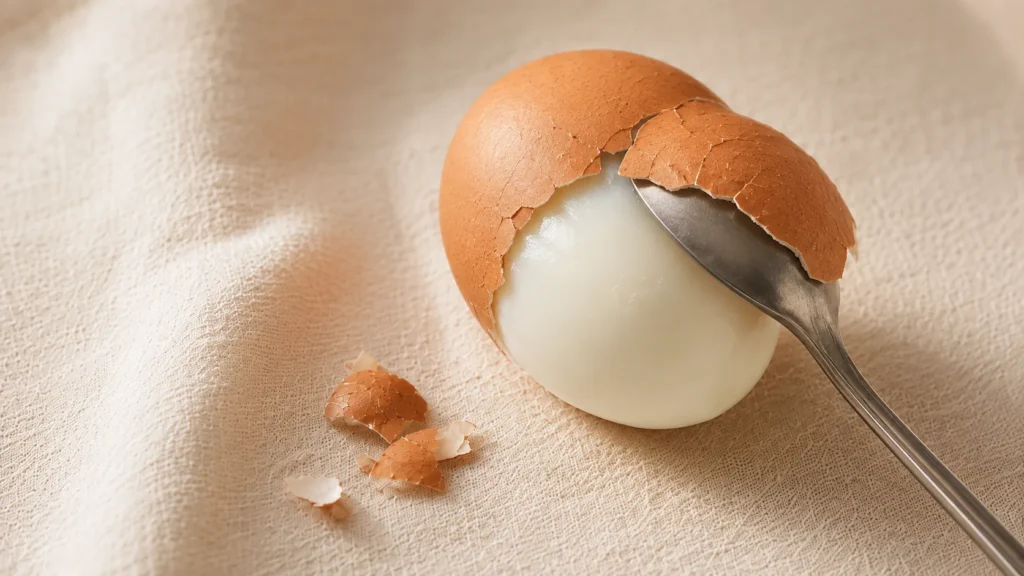
Anything under six minutes, don’t bother peeling — the white won’t hold. Serve it in the shell. Full peeling technique for firmer eggs is in the peeling guide.
Why soft boiled eggs go wrong
Watery, undercooked white
The classic failure, and it has three usual causes: an extra-large or jumbo egg cooked on large-egg timing, water at a simmer instead of a rolling boil, or a cold-water start without adjusting the count. The simmer is the sneaky one — it looks close enough and isn’t.
Yolk set when you wanted it runny
Almost always a missing ice bath. An egg pulled at six minutes and left on the counter keeps cooking; by the time you’ve found the salt, it’s a 6:45 egg. The other candidate is a small egg cooked on large-egg timing.
Shell tore the white away
Freshness. Very fresh eggs bond hard to their shell membrane and soft boiled whites are too delicate to survive the fight. Either use eggs that have been in the fridge a week or more, serve them in the shell, or steam them instead — steam gets under the membrane far more effectively than water.
Soft boiled, half boiled, and jammy — the differences
Three names that get used interchangeably and shouldn’t be. If you want the full picture of what happens minute by minute inside the shell, see doneness and yolk texture.
- Soft boiled (6:00) — white fully set and sliceable, yolk runny. The general-purpose soft egg.
- Half boiled (5:00) — white barely set and almost pourable, yolk fully liquid. The Singaporean and Malaysian kopitiam breakfast egg, cracked into a saucer with dark soy sauce and white pepper. It has its own half boiled egg timer.
- Jammy (6:45) — yolk set at the rim, custardy in the centre, holds its shape when halved. The ramen egg, and the base for marinated ajitama. Jammy egg timer.
A note on runny yolks and food safety
A soft boiled egg’s white and yolk don’t reach the temperature that eliminates salmonella, so a small risk remains — the same reason egg food safety is worth reading once. For most healthy adults that risk is very low, particularly with refrigerated commercially graded eggs. It matters more for people who are pregnant, very young, elderly, or immunocompromised — for them, pasteurised eggs or a fully cooked egg is the safer call. We’d rather say this plainly than pretend the question doesn’t exist.
Soft boiled egg questions
How long do you boil an egg for a soft boiled egg?
Six minutes for a large egg from the fridge into already-boiling water, then one minute in ice water. That gives a fully set white and a runny yolk. Five minutes leaves the white barely set and the yolk completely liquid; 6:45 turns the yolk jammy.
Do you put soft boiled eggs in cold water after cooking?
Yes — one minute in ice water. It isn’t only about handling temperature: a hot egg keeps cooking inside its shell, and across a doneness window barely two minutes wide, that carryover is enough to turn a runny yolk into a set one.
Why won’t my soft boiled eggs peel?
Usually because they’re very fresh. Fresh whites bond tightly to the shell membrane, and a soft boiled white is too fragile to survive being pulled off it. Use eggs at least a week old, chill them thoroughly first and use the spoon technique, or serve them in the shell and skip peeling entirely.
Is it safe to eat a runny egg yolk?
For most healthy adults the risk is low, especially with refrigerated, commercially graded eggs — but a soft boiled egg doesn’t get hot enough to eliminate salmonella, so the risk isn’t zero. Anyone pregnant, very young, elderly or immunocompromised should use pasteurised eggs or cook eggs through.
What’s the difference between soft boiled and poached eggs?
The shell. A soft boiled egg cooks inside its shell in boiling water for a set time; a poached egg is cracked out and cooked in barely simmering water. Soft boiled eggs are far more repeatable — the shell keeps the egg together, so the only variable is time.
Thirty seconds decides this one
Pick your egg size and the timer does the arithmetic, sounds an alarm, and starts the ice bath the moment the eggs come out.