Lower large eggs straight from the fridge into already-boiling water, cook for 11 minutes, then move them immediately into ice water for 5 minutes. That gives a fully set, tender yolk with no grey ring — and shells that peel in sheets.
11 minutes, large egg, straight from the fridge, into boiling water. Fully set, no grey ring.
Fully set, no grey ring
Eleven minutes. Ready when you are.
11:00
The countdown needs JavaScript. The times below are correct without it.
Start it the moment the eggs go into the boiling water.
Method, altitude, and other eggs
Only matters above about 3,000 ft. If your city isn’t listed, you’re fine on the standard times. Learn more
| Doneness | Medium | Large | Extra large | What you get |
|---|---|---|---|---|
| Jammy | Custardy centre, the ramen-egg standard | |||
| Medium | Set edge, soft fudgy centre | |||
| Hard | Fully set, no grey ring |
The 11-minute method
Hard boiled eggs fail in three specific ways: a grey-green ring around the yolk, a chalky dry texture, and shells that take the white with them. All three come from the same two decisions — how long the egg cooks, and how fast it stops. Get those right and the rest is detail.
This page is the hard boiled deep dive. If you want the general method that covers every doneness, start with how to boil eggs.
Step 1 — Boil the water first
Use a pot wide enough that the eggs sit in a single layer, and enough water to cover them by about an inch. Bring it to a full rolling boil — large, constant bubbles, not the lazy shimmer of a simmer. Starting from boiling water rather than cold is what makes the timing repeatable, because cooking begins at a moment you can actually see.
Step 2 — Lower the eggs in on a spoon
One at a time, gently. Dropped eggs crack on the pot base, and a cracked egg bleeds white into the water and cooks unevenly. Use eggs straight from the fridge — every time on this site assumes fridge-cold, so a room-temperature egg needs about a minute less.
Step 3 — 11 minutes at a steady boil, lid off
Start the timer the moment the last egg is in. Keep the water at a real boil; if it drops to a simmer the eggs cook slower than the clock says. Leave the lid off so you can see what the water is doing.
Egg size shifts this by about 30 seconds per step: 10:00 for small, 10:30 medium, 11:00 large, 11:30 extra large, 12:00 jumbo. Living above 3,000 feet? Add a minute, and see boiling eggs at altitude for why water behaves differently up there.
Step 4 — Five full minutes in ice water
Have the bowl ready before the timer goes. This step is not optional and it is not just about cooling: it stops carryover cooking (which is what creates the grey ring), and the rapid contraction inside the shell is most of what makes an egg peel cleanly. Cold tap water is a compromise; actual ice is the thing.
Step 5 — Peel from the wide end
Crack the shell all over until it looks like a mosaic, then start at the wide end where the air pocket sits and peel under cool running water. Full technique, including what to do when shells refuse to cooperate, is in the peeling guide.
Hard boiled egg times by size
| Egg size | Cook time | Ice bath |
|---|---|---|
| Small | 10:00 | 5:00 |
| Medium | 10:30 | 5:00 |
| Large | 11:00 | 5:00 |
| Extra large | 11:30 | 5:00 |
| Jumbo | 12:00 | 5:00 |
Want them a shade firmer for slicing or deviled eggs? Add a minute. Want the centre just barely moist? Take one off. For everything between soft and hard, the full timing chart covers every doneness at every size.
Why hard boiled eggs go wrong
The grey-green ring
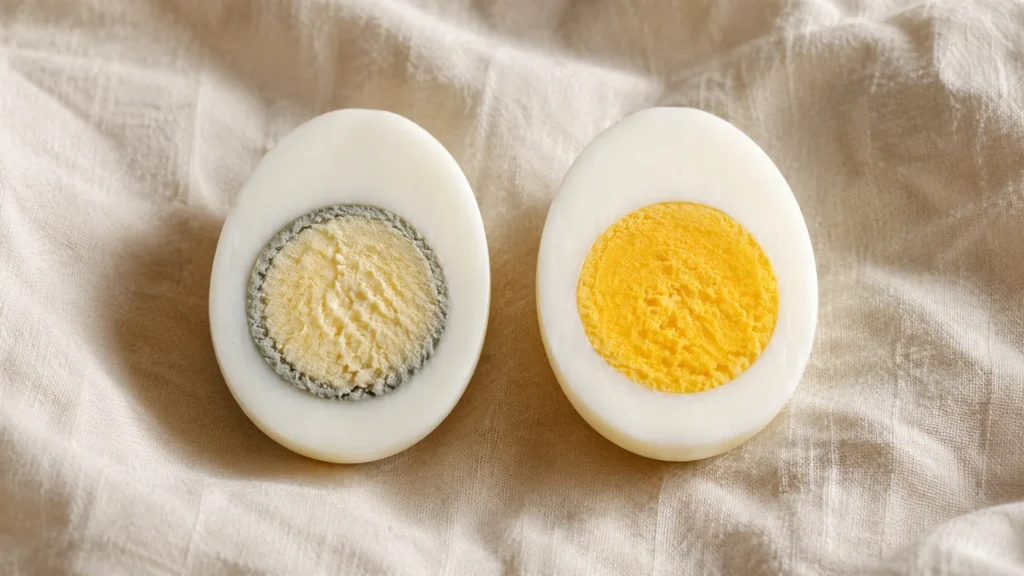
That ring is iron sulfide. Sulfur compounds in the white react with iron in the yolk, and the reaction accelerates with heat and time — so it’s a signature of overcooking, not of a bad egg. It’s harmless to eat but it tastes flat and slightly sulfurous.
Two fixes, both already in the method above: don’t run much past 12 minutes, and get the eggs into ice water immediately. An egg left sitting in hot water after the heat goes off keeps cooking for several minutes, which is exactly when the ring forms.
Chalky, dry yolks
Same cause, further along. Yolk proteins set around 158°F and keep tightening past that, squeezing out moisture. Eleven minutes puts the centre just past set; fifteen makes it crumble into dust. If your eggs are consistently chalky at the right time, your water is likely boiling harder than it needs to — a steady boil, not a violent one.
Shells that tear the white off
Usually egg freshness. A fresh egg white is slightly acidic and bonds to the shell membrane; as an egg ages in the fridge it loses CO₂, the white’s pH rises, and that bond weakens. This is why older eggs peel better — a week or two in the fridge is ideal for hard boiling, which is a rare case of the less-fresh option being correct.
If your eggs are unavoidably fresh, steaming instead of boiling gets under that membrane more aggressively, and an Instant Pot does it best of all.
Cracked shells in the pot
Temperature shock or impact. Lower eggs on a spoon rather than dropping them, keep the boil steady rather than violent, and if it keeps happening, try a cold-water start where the eggs and water heat together — gentler on shells, at the cost of some timing precision. The guide to stopping eggs cracking covers the rest.
How many eggs can you boil at once?
As many as fit in one layer with an inch of water over them — and here’s the part that surprises people: the cook time doesn’t change. A dozen eggs cook in the same 11 minutes as one. What changes is the recovery time; a cold dozen drops the water temperature, so it takes longer to come back to a rolling boil. Wait for the boil to return, then start the timer, and use a bigger pot so the recovery is quick.
Making hard boiled eggs ahead
They hold better than any other doneness, which is why they anchor most meal prep. Cook, ice-bath, and refrigerate in the shell — the shell is a better container than anything you own. USDA guidance is up to one week refrigerated, peeled or unpeeled, with the eggs getting into the fridge within two hours of cooking. Peel the morning you want them; peeled eggs dry out and need a sealed container.
Don’t freeze them. The white’s water separates on thawing and the texture turns rubbery and weeping. Freezing works for cooked yolks alone, and not much else.
What to do with a dozen hard boiled eggs
Hard boiled is rarely the destination — it’s the ingredient. The three that account for most of them: egg salad, which wants the yolk fully set so it mashes rather than smears; deviled eggs, where a firm yolk pipes cleanly and a wet one doesn’t; and simply eaten cold with salt, which at roughly 6 grams of protein each is why they anchor so much meal prep.
Other ways to hard boil
A pot isn’t the only route, and two of the alternatives peel noticeably better:
- Steamed — 12:30 for hard. Gentler on shells and consistently the easiest to peel. Steamed egg timer.
- Instant Pot — the 5-5-5 method: 5 minutes at high pressure, 5 minutes natural release, 5 minutes in ice. Peels beautifully and ignores altitude entirely. Instant Pot egg timer.
- Air fryer — 15 minutes at 270°F / 130°C, no water at all. Air fryer egg timer.
All of them, plus the trade-offs between them, are compared on the methods hub.
Hard boiled egg questions
How long should you boil eggs for hard boiled eggs?
Eleven minutes for a large egg lowered into already-boiling water from the fridge, followed by five minutes in ice water. Small eggs need 10:00, jumbo 12:00. If you start eggs in cold water instead, count roughly 8:30 from the moment the water reaches a full rolling boil.
Why are my hard boiled eggs green around the yolk?
That’s iron sulfide, formed when sulfur in the white reacts with iron in the yolk — it’s a sign of overcooking, not spoilage. It’s safe to eat but tastes dull. Keep the cook under about 12 minutes and move the eggs into ice water the second the timer sounds, because an egg sitting in hot water keeps cooking.
Should you boil eggs from cold water or boiling water?
Boiling water, if you want repeatable results — cooking starts at a moment you can see, and the timing holds every time. A cold-water start is gentler on shells and worth using if yours crack, but the egg begins cooking on the way up, so you cook for less time from the boil, not more.
Do older eggs really peel more easily?
Yes, and it’s chemistry rather than folklore. Eggs lose carbon dioxide through the shell as they age, which raises the white’s pH and weakens its bond to the shell membrane. Eggs that have been in your fridge a week or two peel noticeably better than eggs bought that morning.
How many hard boiled eggs can you cook at once?
As many as fit in a single layer under an inch of water — and the cook time stays at 11 minutes regardless. More eggs cool the water more, so it takes longer to return to a boil; wait for the rolling boil to come back before starting the timer.
Can you overcook hard boiled eggs?
Yes. Past about 12 minutes the yolk turns chalky and dry and the grey ring sets in, and past 15 it becomes genuinely crumbly. Nothing dangerous happens, but the texture and flavour degrade with every extra minute.
Eleven minutes, timed for you
Set your egg size and the timer adjusts, counts down, sounds an alarm, then runs the five-minute ice bath automatically.